
PSCAD Modeling & Studies for Grid Interconnection and Compliance
We build PSCAD/EMT models for utility interconnection and grid-code compliance - and run the studies that rely on them: Model Quality Tests, IEEE 2800 conformity, TOV/TRV, and root cause analysis. Backed by deep OEM expertise and validated to pass on first submission.
800+ projects and 150+ GW supported across all 7 US ISO/RTO markets
Facing These Project Modeling Challenges?
Accepted models, actionable insights
Deliverable Acceptance
We stand behind every model and study until the utility or ISO accepts it - our goal is the project outcome.
Accepted on 1st submissionFaster Model Development
Automation handles the tedious, repetitive work so our engineers focus on problem-solving - compressing timelines without cutting corners.
30–50% faster cyclesGrid-Code Compliance Ready
IEEE 2800, ERCOT MQT, and PRC-029 ride-through alignment built in - models are documented, defensible, and submission-ready.
Engineering Insights
Deep IBR OEM experience means we know what to look for - turning study results into clear answers and faster resolution.
Engineering capabilities
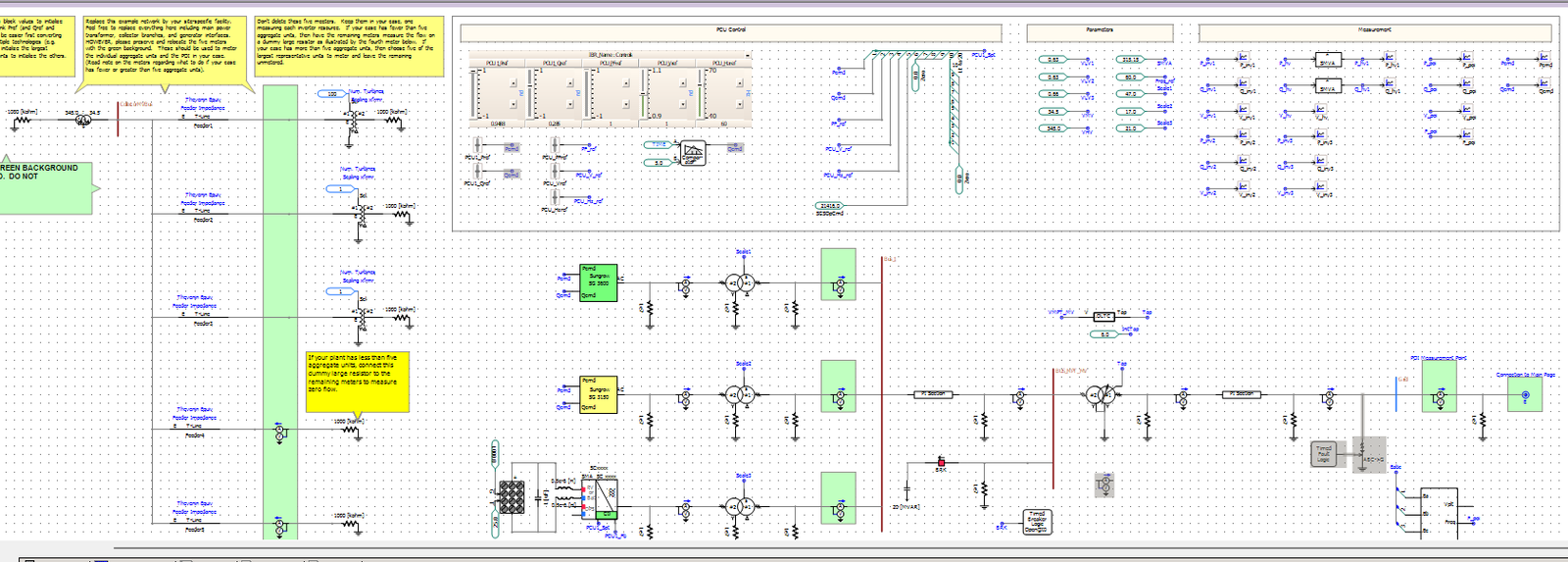
PSCAD Model Development
Project-level and large-scale PSCAD models for generation, transmission, and large loads - built for utility interconnection.
Model Validation
Validation and benchmarking of manufacturer-provided models against field and commissioning data.
Root-Cause & Event Analysis
Recreating field events from measurements and running sensitivity studies to explain oscillations, ride-through, and control interactions.
Weak Grid & SSO/SSCI Studies
System-level weak-grid, sub-synchronous oscillation, and SSCI studies - integrating multiple IBR plant models to screen regional stability risk.
TOV, TRV & Protection Studies
Temporary overvoltage (TOV) and transient recovery voltage (TRV) studies, plus PSCAD-based protection coordination and relay performance.
Grid Code Compliance
IEEE 2800 conformity, ERCOT Model Quality Tests (MQT), and PRC-029 ride-through modeling - with ISO/RTO submission-ready documentation.
From scoping to acceptance
Scoping
We align on the project or study goal, ISO requirements, and grid topology up front.
ISO requirements + project goals
Data & OEM Coordination
Gather OEM models, as-left settings, and network data - coordinating directly with the IBR manufacturer.
OEM models + plant data
PSCAD Build
Build the EMT model with our automation tools, so engineers focus on control tuning and problem-solving.
Automated workflows + control tuning
Analyze & Tune
Post-process and analyze results, tune and rerun as needed, and catch issues before they reach the ISO.
Issues flagged pre-submittal
Submission & Acceptance
Deliver a quality-controlled package with defensible methodology, and support the back-and-forth until the utility or ISO accepts it.
Supported through acceptance
Real Projects, Real Outcomes
From single-plant interconnection models to region-wide SSO studies - this is what we do every day.
Questions we get asked before a project starts
Scope, timelines, ISO requirements, and what we need from you to begin.
When do I need an EMT (PSCAD) study instead of a standard RMS/phasor study?
RMS tools like PSS/E and TSAT work well for large-system planning, but they average out the fast control behavior of power electronics. Solar, wind, BESS, and large power-electronic loads such as AI data centers respond in milliseconds. EMT simulation captures that behavior, which you need for:
- Weak-grid (low short-circuit strength) performance
- Sub-synchronous oscillations near series-compensated lines (SSR/SSCI)
- Control interactions between nearby plants, HVDC, or FACTS devices
- Ride-through and protection performance
NERC recommends EMT studies in exactly these situations, and ISOs increasingly require them.
Which ISOs and utilities require PSCAD models?
Requirements are tightening across the board:
- ERCOT requires PSCAD models and model quality tests (MQTs) for IBRs and is now extending EMT model requirements to large loads and data centers.
- PJM requires a PSCAD model for projects moving past Decision Point II.
- MISO and other FERC-jurisdictional regions collect EMT models under FERC Order 2023.
- NERC has put revised model verification requirements in effect, and further EMT standards are in development.
How long does a typical PSCAD modeling and study effort take?
It depends on scope and how good the vendor models are. A standard plant model build and MQT package typically takes a few weeks. Larger work, such as SSR/SSCI screening, weak-grid studies, or islanded data center studies, takes longer. Our automated test and post-processing workflows cut down the time spent on repeated runs, so we can turn studies around faster and absorb late design changes without starting over.
We're a utility. When should we require EMT studies, and can you do system-level studies beyond a single plant?
Yes. NERC expects transmission planners to use objective, risk-based screening to decide when EMT studies are needed. Typical triggers are:
- Low system strength
- High IBR concentration
- Series compensation
- Nearby HVDC/FACTS
- Large data center loads
We help utilities set those screening criteria and EMT model requirements. We also review developers' PSCAD submittals for quality and how well they match the real equipment. For larger studies, we build multi-plant, area-level EMT models from your planning cases to evaluate plant-to-plant interactions, oscillations, weak-grid stability, and large-load ride-through. Those are the risks a single-plant study can't show.
What do we need to provide to get a PSCAD study started?
Most of it already exists in your interconnection package. Typically we ask for:
- Single-line diagram and plant layout: the main power transformer(s), collector system, and reactive devices
- OEM PSCAD models: for the inverters or turbines, the plant controller, and any STATCOM or BESS, with the model version, user guides, and the site-specific parameter settings
- Your PSS/E model: the power flow and dynamic models, so we can benchmark the PSCAD model against them
- Equipment data: transformer impedances, X/R ratios, and tap settings; collector cable lengths and impedances; and protection and ride-through settings
- Grid data at the point of interconnection: short-circuit levels or a system case from the ISO or utility, plus the study scope or model requirements they've specified
For data center and large-load studies, we also need: the load composition, UPS and power electronics details, and any on-site generation.
We'll send you a tailored data request checklist at kickoff. Gaps don't have to hold up the start. We flag what's missing, use typical values with documented assumptions where it's appropriate, and work directly with your OEM to get the right models.
What makes INS different from other EMT study providers?
INS engineers have deep EMT experience, including OEM-side work on SSR/SSCI analysis and control design. We pair that with automation and AI-assisted workflows for building cases, running batches, and reviewing results. You get faster turnaround, consistent and well-documented results, and a team that stays with you through ISO review and model updates.
Still have a question? Talk to our PSCAD team and we'll get back to you.
Stop Guessing. Get Your PSCAD Model Accepted.
Our engineers know the requirements of every major US ISO and have the submittal experience to match - we see every model and study through to acceptance.